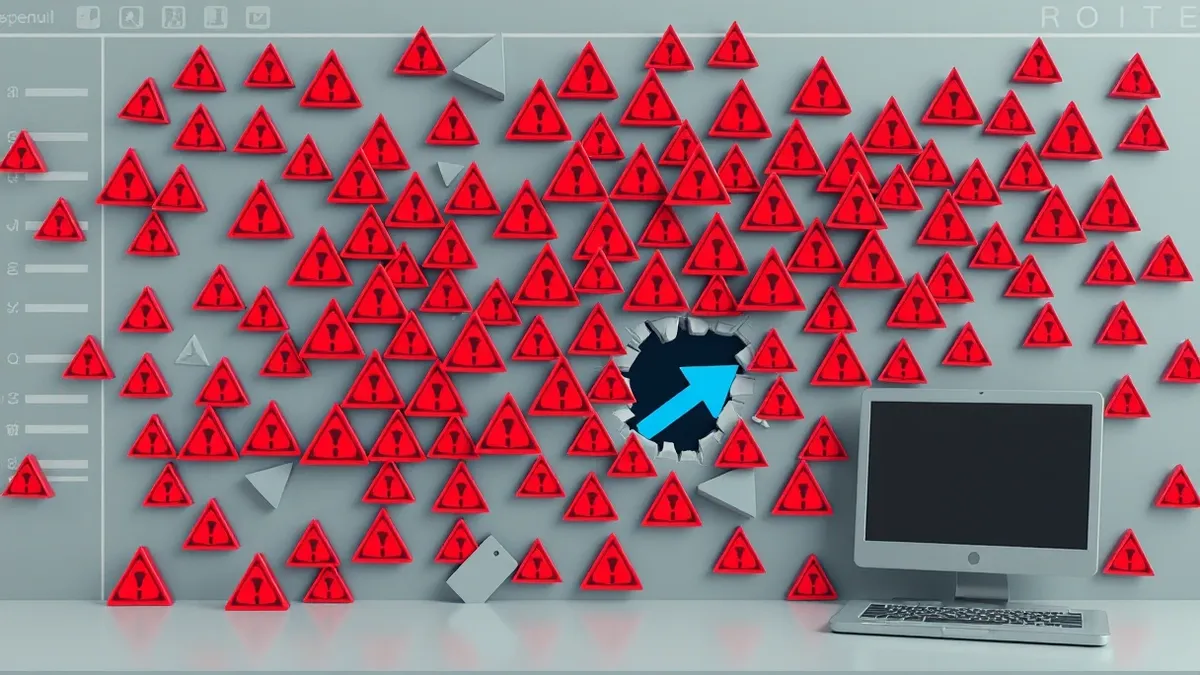
User and entity behavior analytics fails when teams ignore context, treat all entities equally, or skip baseline maintenance. Fix these errors by defining strict data quality rules, segmenting entities by role, and integrating alert outputs directly into incident response workflows to reduce noise and improve detection accuracy.
Mistake 1: Ignoring Data Quality and Completeness
User and entity behavior analytics relies entirely on the volume and consistency of telemetry data. When logs are missing fields, timestamps are skewed, or collection gaps exist, the statistical models cannot build accurate baselines. You feed incomplete data into the system, and it produces incomplete or erroneous conclusions about what constitutes normal behavior. A gap in login logs might look like a sudden cessation of activity, triggering a false alert for a dormant account, or worse, masking a compromised account that has gone quiet to avoid detection.
Why it hurts:
Poor data quality creates blind spots where threats hide. This leads to both missed detections and excessive false positives, eroding trust in the tool.
The fix:
Implement strict data validation pipelines before ingesting logs into the analytics platform. Verify that critical fields such as user identifiers, source IP addresses, and timestamps are present and correctly formatted. Regularly audit data sources for continuity and completeness. Consider reading our guide on detection engineering to learn how to structure data pipelines that support reliable behavioral modeling rather than just raw log storage.
Mistake 2: Treating All Entities as Equal
Not all users or devices behave the same way. A database administrator accesses different systems than a marketing intern. A server hosting a public web application generates vastly different traffic patterns than an internal file server. Grouping all entities into a single baseline averages out these differences, creating a generic profile that fits no one well. This approach dilutes the sensitivity of the analytics engine, making it harder to spot deviations that are specific to a particular role or function.
Why it hurts:
Generic baselines generate noise because they flag normal role-specific behavior as anomalous. An analyst reviewing alerts for a database administrator will see constant false positives for high-volume queries, leading to alert fatigue. Meanwhile, subtle anomalies that deviate slightly from the average but are significant for that specific role may be ignored or missed entirely.
The fix:
Segment entities into logical groups based on role, department, or function. Create separate baselines for each group. This allows the system to learn the specific behavioral norms for a database administrator versus a standard user. Ensure these segments are reviewed and updated regularly as organizational structures change. This approach aligns with principles found in a mature threat intelligence program, where context determines the relevance of indicators.
Mistake 3: Neglecting Baseline Maintenance
Baselines are not static truths; they are snapshots of behavior at a specific point in time. User roles change, new applications are deployed, and network architectures evolve. If you do not update the baselines, the system continues to compare current behavior against outdated norms. A user who recently gained elevated privileges will appear anomalous because their new access patterns do not match their previous historical data. This creates a period of vulnerability where legitimate changes trigger alerts, or conversely, where new malicious activities blend in with the changing legitimate noise.
Why it hurts:
Stale baselines reduce detection accuracy over time. As the organization grows and changes, the gap between the baseline and reality widens. This leads to a growing number of false positives that analysts must triage, wasting time and resources. It also means that the system becomes less sensitive to genuine threats that exploit changes in the environment.
The fix:
Automate baseline updates where possible, or establish a regular schedule for manual review and adjustment. Trigger baseline recalculations when significant changes occur, such as new software deployments or major organizational restructuring. Monitor the drift between current behavior and the baseline to identify when manual intervention is needed. This process mirrors the continuous improvement cycle seen in incident response runbooks, where procedures are updated based on new experiences and environmental shifts.
Mistake 4: Overlooking Contextual Enrichment
Behavioral anomalies are meaningless without context. Knowing that a user logged in from an unusual location is interesting, but knowing they logged in from an unusual location during a time they are known to be on leave is critical. Without enriching behavioral alerts with identity data, asset criticality, and threat intelligence, analysts lack the information needed to prioritize and investigate effectively. You see the anomaly, but you do not understand its significance or potential impact.
Why it hurts:
Lack of context forces analysts to spend excessive time gathering additional information manually. This delays response times and increases the risk of missing critical threats. It also makes it difficult to correlate behavioral anomalies with other indicators of compromise, such as known malicious IP addresses or compromised credentials, reducing the overall effectiveness of the security operations center.
The fix:
Integrate user and entity behavior analytics with identity and access management systems, asset management databases, and threat intelligence platforms. Enrich alerts with context such as user role, device type, geographic location, and known threat indicators. This allows analysts to quickly assess the severity and relevance of an alert, focusing their efforts on the most critical incidents.
Mistake 5: Failing to Tune Alert Thresholds
Default alert thresholds are rarely optimal for any specific environment. They are designed to be generic, often erring on the side of caution to ensure broad coverage. This results in a high volume of low-priority alerts that clutter the analyst's workspace. Without careful tuning, the system becomes a noise generator rather than a detection tool. Analysts become desensitized to alerts, potentially overlooking genuine threats amidst the sea of false positives.
Why it hurts:
Excessive noise leads to alert fatigue and reduced analyst productivity. When analysts are bombarded with irrelevant alerts, they may start to ignore or dismiss alerts altogether, including those that indicate genuine security incidents. This undermines the entire purpose of implementing behavioral analytics and weakens the organization's defensive posture.
The fix:
Start with conservative thresholds and gradually adjust them based on historical data and analyst feedback. Use feedback loops to mark false positives and adjust the model accordingly. Regularly review alert volumes and types to identify patterns of noise and adjust thresholds to suppress them. This iterative tuning process is similar to refining detection engineering rules, where precision and recall are balanced to optimize detection capabilities.
See also: Coordinated Vulnerability Disclosure: Meaning, Process, and Risk Management · Exposure Management: Concrete Benefits and Hidden Limitations
Mistake 6: Ignoring Service Accounts and Automated Processes
Service accounts and automated processes often generate high volumes of repetitive traffic. If these are not properly identified and excluded from human-centric behavioral models, they skew the baselines and generate false positives. For example, a backup process running at night might look like unusual data exfiltration if the system does not recognize it as a known automated task. Failing to distinguish between human and machine behavior leads to inaccurate models and wasted investigative effort.
Why it hurts:
Machine-generated traffic can mask human-driven threats or create false alarms that distract analysts. If service accounts are not properly segmented, their consistent but high-volume activity can distort the baseline for human users, making it harder to detect subtle deviations in human behavior. This reduces the sensitivity of the analytics engine for the threats that matter most.
The fix:
Identify and tag all service accounts and automated processes. Exclude them from human-centric behavioral models or create separate baselines for them. Ensure that these accounts are monitored for changes in their behavior, as compromised service accounts can be used for lateral movement or data exfiltration. This approach requires careful integration with identity management systems and may benefit from insights on network enumeration to identify all automated entities on the network.
Mistake 7: Lack of Integration with Incident Response
Detecting an anomaly is only the first step. If the user and entity behavior analytics platform does not integrate seamlessly with incident response workflows, the value of the detection is diminished. Alerts must be actionable, with clear next steps and integration into ticketing systems, communication channels, and response playbooks. Without this integration, analysts must manually transfer information between systems, increasing response times and the risk of errors.
Why it hurts:
Poor integration leads to delayed response and inconsistent handling of incidents. Analysts may struggle to correlate behavioral alerts with other security events, hindering their ability to understand the full scope of an attack. This fragmentation reduces the effectiveness of the security operations center and increases the time to contain threats.
The fix:
Integrate user and entity behavior analytics with security information and event management systems, ticketing platforms, and incident response runbooks. Ensure that alerts include all necessary context and recommended actions. Automate the creation of incident tickets and assignment of responders based on the severity and type of alert. This streamlined workflow enables faster and more consistent response to behavioral anomalies.
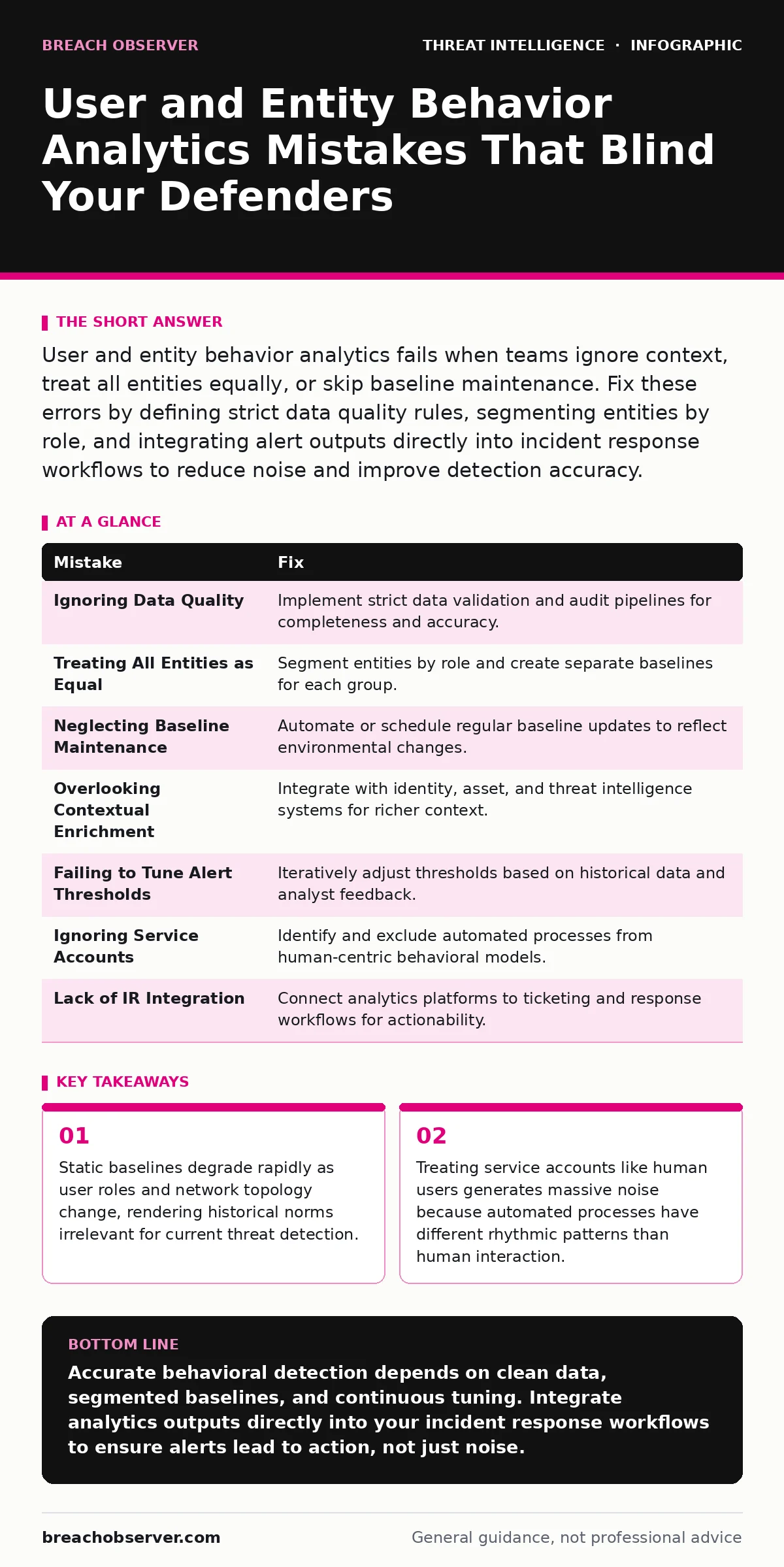
| Mistake | Fix |
|---|---|
| Ignoring Data Quality | Implement strict data validation and audit pipelines for completeness and accuracy. |
| Treating All Entities as Equal | Segment entities by role and create separate baselines for each group. |
| Neglecting Baseline Maintenance | Automate or schedule regular baseline updates to reflect environmental changes. |
| Overlooking Contextual Enrichment | Integrate with identity, asset, and threat intelligence systems for richer context. |
| Failing to Tune Alert Thresholds | Iteratively adjust thresholds based on historical data and analyst feedback. |
| Ignoring Service Accounts | Identify and exclude automated processes from human-centric behavioral models. |
| Lack of IR Integration | Connect analytics platforms to ticketing and response workflows for actionability. |
Key takeaways
- Static baselines degrade rapidly as user roles and network topology change, rendering historical norms irrelevant for current threat detection.
- Treating service accounts like human users generates massive noise because automated processes have different rhythmic patterns than human interaction.
Accurate behavioral detection depends on clean data, segmented baselines, and continuous tuning. Integrate analytics outputs directly into your incident response workflows to ensure alerts lead to action, not just noise.
Frequently asked questions
How long does it take to establish accurate baselines for user and entity behavior analytics?
Baseline establishment typically takes several weeks of consistent data collection to capture normal behavioral patterns across different times and conditions.
Can user and entity behavior analytics detect insider threats?
Yes, by identifying deviations from normal user behavior, such as unusual access patterns or data transfers, it can flag potential insider threat activities for investigation.
What is the difference between user and entity behavior analytics and traditional SIEM?
Traditional SIEM relies on known signatures and rules, while behavioral analytics uses statistical models to detect anomalies based on deviations from established norms.
How do I handle false positives in user and entity behavior analytics?
Use feedback loops to mark false positives, adjust thresholds, and refine baselines to reduce noise and improve detection accuracy over time.
How this guide was produced: written by the Breach Observer editorial team with AI assistance, checked against the public references listed below, and reviewed when the facts change. See our editorial policy or report an error.