
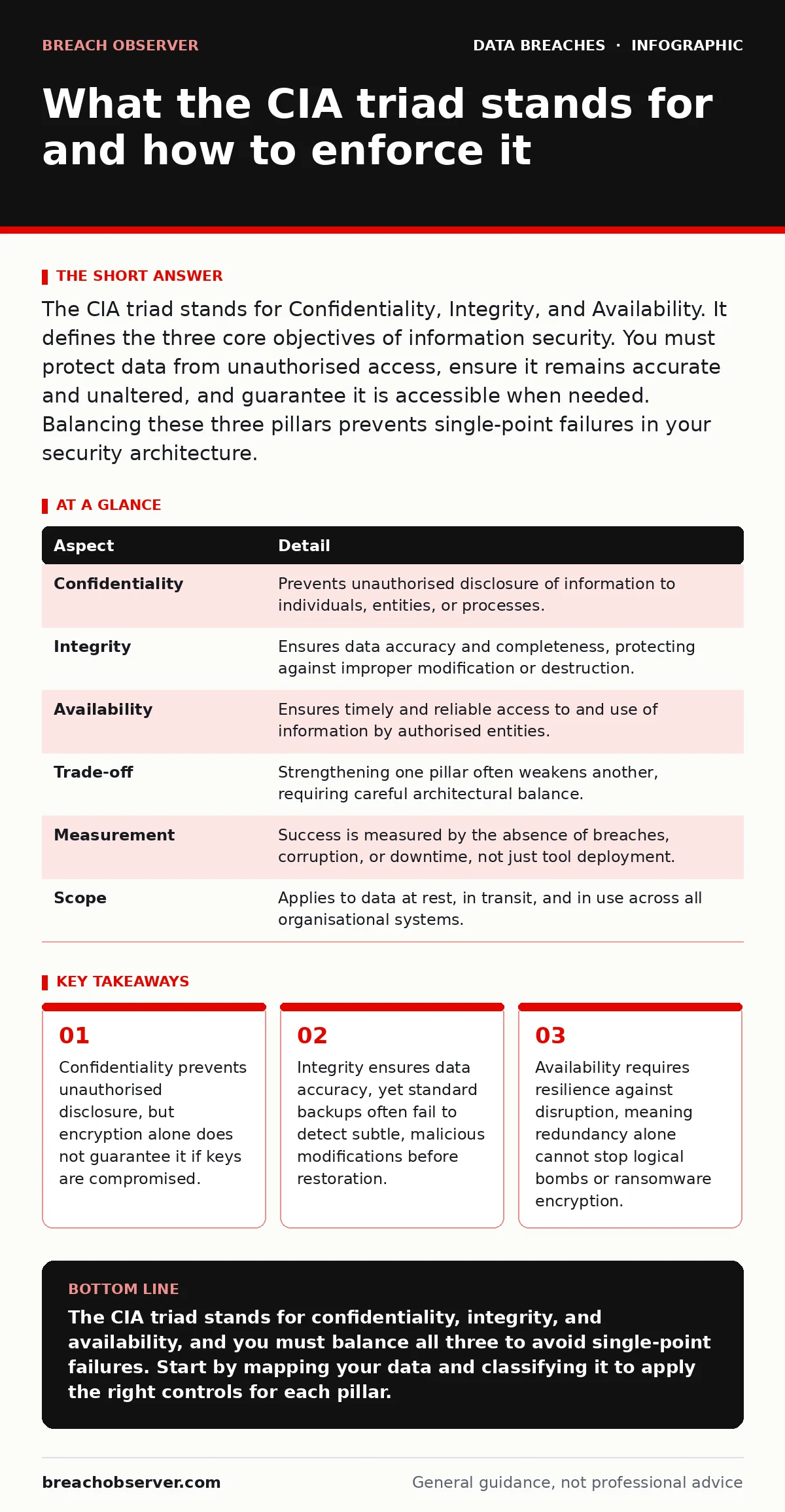
The CIA triad stands for Confidentiality, Integrity, and Availability. It defines the three core objectives of information security. You must protect data from unauthorised access, ensure it remains accurate and unaltered, and guarantee it is accessible when needed. Balancing these three pillars prevents single-point failures in your security architecture.
The CIA triad stands for confidentiality, integrity, and availability
Imagine a library where books are locked in glass cases, never touched by hands, and always available during opening hours. This analogy captures the tension between protection and utility. The CIA triad stands for Confidentiality, Integrity, and Availability. These three principles form the foundation of information security management. You cannot secure an organisation by focusing on only one pillar. Neglecting any single element creates a specific vulnerability that attackers exploit. Confidentiality ensures that information is accessible only to those authorised to view it.
Integrity guarantees that data remains accurate, complete, and unaltered by unauthorised parties. Availability ensures that authorised users can access information and assets when required. These definitions sound simple, but their implementation involves complex trade-offs. You must balance strict access controls with the need for seamless user experience. A system that is perfectly confidential but unavailable is useless to the business. A system that is always available but lacks integrity holds corrupted data that leads to bad decisions. Understanding what the CIA triad stands for helps you evaluate security controls objectively.
| Aspect | Detail |
|---|---|
| Confidentiality | Prevents unauthorised disclosure of information to individuals, entities, or processes. |
| Integrity | Ensures data accuracy and completeness, protecting against improper modification or destruction. |
| Availability | Ensures timely and reliable access to and use of information by authorised entities. |
| Trade-off | Strengthening one pillar often weakens another, requiring careful architectural balance. |
| Measurement | Success is measured by the absence of breaches, corruption, or downtime, not just tool deployment. |
| Scope | Applies to data at rest, in transit, and in use across all organisational systems. |
How confidentiality works in practice
Confidentiality relies on the principle of least privilege. You grant users only the minimum access necessary to perform their duties. Encryption is the primary technical control here. It transforms readable data into ciphertext that is unintelligible without the correct decryption key. However, encryption does not solve access management. If an attacker obtains valid credentials, they can decrypt data legitimately. This is why you must combine encryption with strong identity verification. Multi-factor authentication adds a layer of defence against stolen passwords. See our guide on password reuse to understand how credential sharing undermines this layer.
Confidentiality also extends to data in transit. Secure protocols like TLS protect data moving between servers and clients. Without these protocols, attackers can intercept sensitive information on public networks. You must also consider data at rest. Databases, file servers, and backup tapes store vast amounts of sensitive information. If physical security fails, attackers can steal drives and decrypt data offline. Key management is the hidden cost of confidentiality. Losing keys means losing data permanently. Storing keys insecurely means losing confidentiality entirely. You must rotate keys regularly and store them in hardware security modules. This adds complexity and cost but is necessary for true protection.
Ensuring data integrity against silent threats
Integrity is often the most neglected pillar. Attackers know that stealing data gets attention, but altering data can cause lasting damage without immediate detection. Integrity controls verify that data has not been changed by unauthorised actors. Cryptographic hash functions are the standard mechanism here. They generate a unique fingerprint for a file or message. Any change to the data, even a single bit, produces a different hash. You compare the current hash with the original to detect tampering. Digital signatures extend this by binding the hash to the signer’s identity. This proves both the source and the integrity of the message. Integrity applies to code as well as data. Supply chain attacks often insert malicious code into legitimate software updates.
You must verify signatures before installing updates. Database integrity is another critical area. Attackers can modify financial records or customer details without triggering alerts. Regular integrity checks and audit trails help detect these changes. See our guide on data exfiltration to understand how attackers move data, but remember they often modify it first to cover their tracks. Integrity is not just about detection. It is about prevention. Access controls that restrict write permissions reduce the attack surface. Immutable storage solutions prevent deletion or modification of logs and backups. This ensures that even if an attacker gains access, they cannot alter the evidence of their presence.
Maintaining availability during disruption
Availability ensures that systems are up and running when needed. This seems straightforward, but it requires proactive planning. Redundancy is the first line of defence. Duplicate servers, network paths, and storage systems ensure that a single failure does not cause downtime. Load balancers distribute traffic across multiple servers, preventing overload. However, redundancy does not protect against all threats. Distributed denial-of-service attacks can overwhelm even redundant systems. You need traffic filtering and rate limiting to mitigate these attacks. Backups are essential for availability, but they are not sufficient. See our guide on backup strategies to learn how to ensure backups are recoverable.
Ransomware attacks encrypt data, rendering it unavailable. Restoring from backups takes time, during which services are down. Immutable backups prevent ransomware from encrypting backup copies. This ensures you have a clean state to restore to. Availability also depends on physical infrastructure. Power outages, natural disasters, and hardware failures can disrupt services. Uninterruptible power supplies and geographically dispersed data centres mitigate these risks. You must test your disaster recovery plans regularly. Plans that have not been tested often fail in real incidents. Availability is a continuous process, not a one-time setup. You must monitor system performance and respond to anomalies quickly.
What people usually get wrong about the triad
Many organisations treat the CIA triad as a checklist rather than a balance. They prioritise confidentiality above all else, implementing strict controls that hinder productivity. This creates a culture of workarounds where employees bypass security to get their jobs done. These workarounds often introduce greater risks than the original controls. Another common mistake is assuming that integrity is guaranteed by confidentiality. If only authorised users can access data, they must not alter it maliciously. This ignores insider threats and compromised accounts. An attacker with valid credentials can modify data without triggering confidentiality alerts. You must monitor for unusual data changes, not just access attempts.
Availability is often seen as an IT problem, not a security problem. Security teams focus on preventing breaches, while IT teams focus on uptime. This siloed approach leaves gaps. A security update might patch a vulnerability but introduce a bug that crashes the system. You must coordinate security and operations teams to ensure updates do not compromise availability. Finally, many organisations forget that the triad applies to all data, not just sensitive data. Public data also needs integrity and availability. Misinformation campaigns can alter public data, damaging reputation. You must apply appropriate controls based on data classification, not just sensitivity.
See also: Privacy Policies: The Real Benefits and Hard Limitations · What Is Biometric Data: Definition, Risks and Practical Meaning
The hidden costs of balancing the pillars
Balancing the CIA triad involves trade-offs that impact budget and performance. Strong encryption adds computational overhead, slowing down systems. This affects availability and user experience. Strict integrity checks require storage and processing power for hashes and signatures. This increases infrastructure costs. Redundancy for availability doubles hardware and licensing costs. You must justify these expenses by assessing risk. Not all data requires the same level of protection. Classify data based on its value and sensitivity. Apply stronger controls to high-value data and lighter controls to low-value data. This optimises resource allocation.
You must also consider the human factor. Complex security controls frustrate users, leading to errors and bypasses. Training and user-friendly design reduce this friction. See our guide on employee data breaches to understand how human error contributes to security failures. The cost of a breach often far exceeds the cost of prevention. However, over-investing in security can stifle innovation and growth. Find the sweet spot where security enables business rather than hindering it. Regularly review your controls to ensure they remain effective and efficient. Technology evolves, and so do threats. Your balance must be dynamic, not static.
Practical steps to enforce the triad
You must integrate the CIA triad into your daily operations. Start with a data inventory. See our guide on data inventory and mapping to understand what you have and where it is. You cannot protect what you do not know exists. Classify data based on its importance and sensitivity. Define access policies for each classification. Implement technical controls that enforce these policies. Monitor for violations and anomalies. Test your controls regularly through penetration testing and audits.
Update your controls as threats evolve. Train employees on the importance of each pillar. Make security a shared responsibility, not just an IT task. Review your incident response plans to ensure they address confidentiality, integrity, and availability failures. Conduct tabletop exercises to simulate breaches and disruptions. Learn from incidents, whether real or hypothetical. Continuously improve your security posture. The CIA triad is not a destination but a journey. You must remain vigilant and adaptable.
Key takeaways
- Confidentiality prevents unauthorised disclosure, but encryption alone does not guarantee it if keys are compromised.
- Integrity ensures data accuracy, yet standard backups often fail to detect subtle, malicious modifications before restoration.
- Availability requires resilience against disruption, meaning redundancy alone cannot stop logical bombs or ransomware encryption.
The CIA triad stands for confidentiality, integrity, and availability, and you must balance all three to avoid single-point failures. Start by mapping your data and classifying it to apply the right controls for each pillar.
Frequently asked questions
Does the CIA triad apply to cloud security?
Yes, the principles are universal. You must ensure cloud providers maintain confidentiality, integrity, and availability, and you share responsibility for these aspects.
How do I measure integrity?
Use cryptographic hashes and digital signatures to verify that data has not been altered since its creation or last authorised modification.
Is availability the same as uptime?
No, uptime measures system availability, but data availability ensures users can access the correct information. A system can be up but hold corrupted data.
Can I prioritise one pillar over others?
You can prioritise based on risk, but neglecting any pillar creates vulnerabilities. For example, high confidentiality with low availability renders data useless during an emergency.
How this guide was produced: written by the Breach Observer editorial team with AI assistance, checked against the public references listed below, and reviewed when the facts change. See our editorial policy or report an error.