
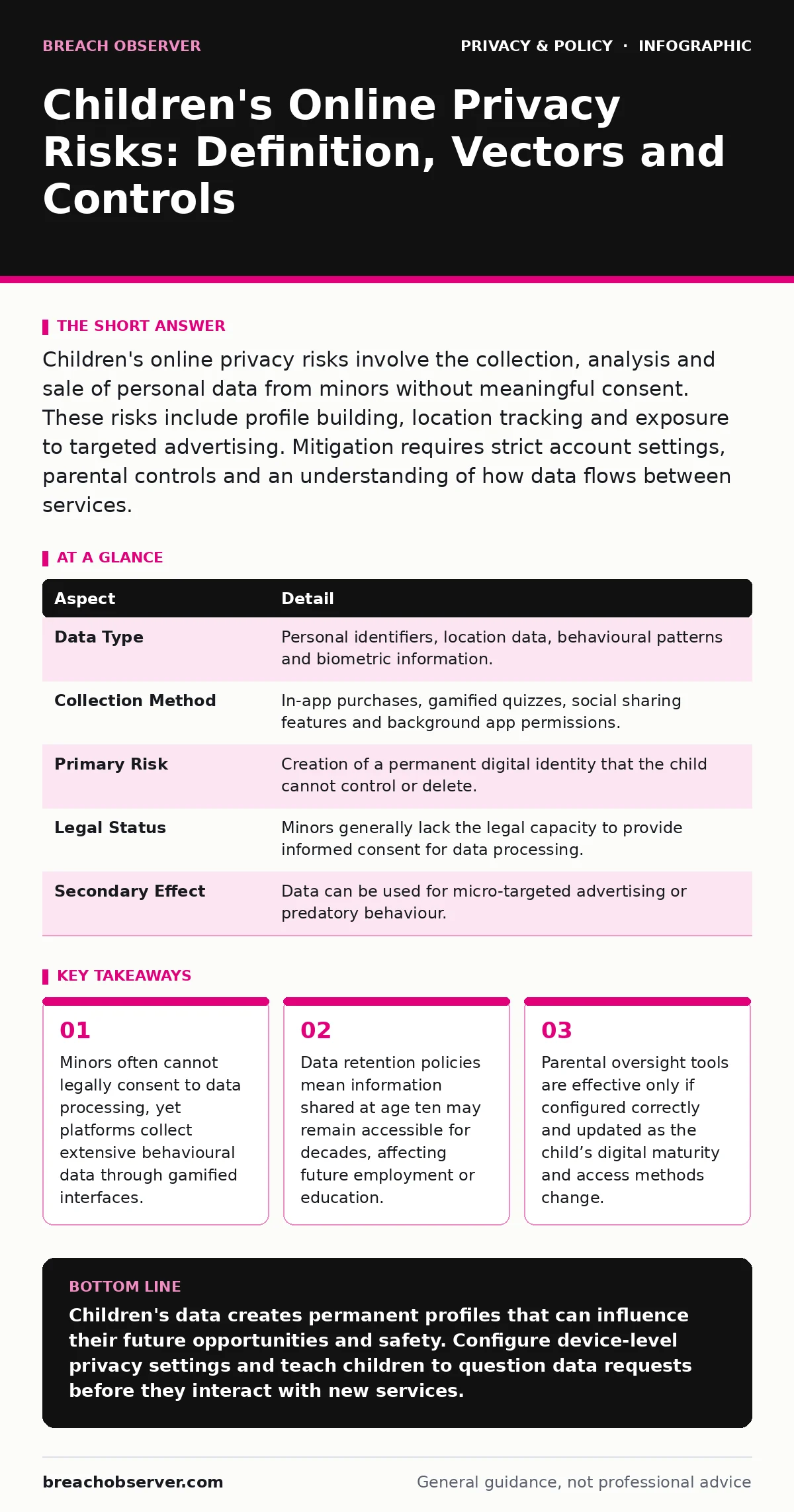
Children's online privacy risks involve the collection, analysis and sale of personal data from minors without meaningful consent. These risks include profile building, location tracking and exposure to targeted advertising. Mitigation requires strict account settings, parental controls and an understanding of how data flows between services.
The Digital Footprint Analogy
Imagine leaving a trail of breadcrumbs through a dense forest. Each crumb represents a piece of personal information: a photo, a location check-in or a game score. Adults can choose where to drop these crumbs. Children, however, often drop them automatically as they walk. The path they leave behind is not just a memory of where they have been. It is a map of who they are, what they like and where they are vulnerable. This trail does not disappear when they leave the forest. It remains visible to anyone who knows how to look for it.
Defining the Risk
Children's online privacy risks refer to the potential for harm resulting from the collection, use or disclosure of personal data relating to minors. This is not merely about strangers seeing a profile picture. It is about systematic data harvesting. Services collect behavioural data, which includes clicks, dwell time and interaction patterns. This data is used to build detailed profiles. These profiles can be sold to third parties or used to manipulate user behaviour. The risk lies in the power imbalance. A child cannot negotiate the terms of data exchange. They accept the default settings, which are often designed to maximise data collection rather than protect privacy.
| Aspect | Detail |
|---|---|
| Data Type | Personal identifiers, location data, behavioural patterns and biometric information. |
| Collection Method | In-app purchases, gamified quizzes, social sharing features and background app permissions. |
| Primary Risk | Creation of a permanent digital identity that the child cannot control or delete. |
| Legal Status | Minors generally lack the legal capacity to provide informed consent for data processing. |
| Secondary Effect | Data can be used for micro-targeted advertising or predatory behaviour. |
How Data Is Extracted
Services rarely ask for sensitive data directly. Instead, they use indirect methods. A game might ask for a username and birthdate. It then records how long the user plays, what levels they fail and what virtual items they purchase. This behavioural data is highly valuable. It reveals psychological traits, such as impulsivity or persistence. When combined with location data from a mobile device, it can reveal home addresses or school routes.
The extraction happens silently. The user is engaged in entertainment or communication, unaware that their interactions are being quantified and stored. This process is often described in privacy policies, which are lengthy documents that few users read. The complexity of these documents is a feature, not a bug. It obscures the extent of data sharing.
Who Is Affected
The risk affects all children who use digital services, but the impact varies. Younger children are more susceptible to online tracking because they lack the cognitive ability to understand the long-term consequences of sharing information. They may not realise that a photo shared in a private group can be saved and redistributed. Older children face different risks.
They are targeted by sophisticated advertising algorithms that exploit their desire for social validation. These algorithms can encourage risky behaviour, such as participating in dangerous challenges or purchasing harmful products. The risk is not limited to social media. Educational platforms, gaming services and smart toys also collect data. The assumption that educational tools are safe is often incorrect. Many ed-tech services share data with third-party analytics providers.
Common Forms of Exposure
Profile building is the most common form of exposure. Services aggregate data from multiple sources to create a comprehensive view of the child. This includes data from biometric data sources, such as facial recognition in photos or voice patterns. Another form is location tracking. Many apps request access to location services for features that do not require it.
For example, a puzzle game does not need to know the user's precise location. However, this data allows the service to infer habits and routines. A third form is social engineering. Malicious actors may pose as peers to extract personal information. This is not a technical breach but a social one. It exploits the child's trust and desire for connection. The data obtained this way is often used for harassment or identity theft.
See also: Employee Data Breaches: How Insider Access Compromises Your Organisation · What happens if VPNs are banned: impact on privacy and connectivity
What People Usually Get Wrong
Many parents believe that deleting an account removes all data. This is incorrect. While the visible profile is removed, the underlying data may remain in backup systems or analytics databases. The right to be forgotten allows users to request data deletion, but enforcement is inconsistent. Companies may retain anonymised data for research purposes. However, true anonymization is difficult.
Re-identification attacks can often link anonymised data back to an individual. Another common mistake is assuming that private accounts are secure. Friends and followers can still see, save and share content. Privacy settings control who can see the post initially. They do not control what happens after the content is accessed. This misunderstanding leads to a false sense of security.
Reducing the Risk
Mitigation requires a layered approach. Start by reviewing app permissions. Disable location access for apps that do not need it. Turn off personalised advertising in device settings. This reduces the amount of data sent to third parties. Use encrypted messaging apps for communication. These services ensure that only the intended recipient can read the messages. However, metadata, such as who you talk to and when, may still be collected.
Teach children to recognise data requests. If a game asks for their full name or school, they should ask a parent. This builds digital literacy. Regularly audit family accounts. Check what apps are linked and what data is shared. Update parental controls as the child grows. What is appropriate for a ten-year-old may not be suitable for a fifteen-year-old. The goal is not to restrict access entirely. It is to ensure informed consent and minimise data exposure.
The Hidden Cost of Convenience
The most significant risk is often invisible. It is the accumulation of data over time. Each interaction adds to the child's digital profile. This profile can be used to make decisions about the child, such as insurance premiums or school admissions. The child has no say in how this data is used. The cost of convenience is high. Free services are paid for with data. The trade-off is rarely made explicit. Understanding this dynamic is the first step towards protection. It shifts the focus from immediate threats, such as cyberbullying, to long-term structural risks. This broader perspective allows for more effective risk management.
Key takeaways
- Minors often cannot legally consent to data processing, yet platforms collect extensive behavioural data through gamified interfaces.
- Data retention policies mean information shared at age ten may remain accessible for decades, affecting future employment or education.
- Parental oversight tools are effective only if configured correctly and updated as the child’s digital maturity and access methods change.
Children's data creates permanent profiles that can influence their future opportunities and safety. Configure device-level privacy settings and teach children to question data requests before they interact with new services.
Frequently asked questions
How long do companies keep children's data?
Companies often retain data for as long as the account exists or until the user requests deletion. Some data may remain in backups or analytics systems for years, even after the account is closed.
Can parents delete data collected from their children?
Yes, parents can usually request data deletion. However, the process can be slow, and companies may retain certain anonymised data for legal or research purposes. It is important to check the specific privacy policy of each service.
Are parental controls enough to protect privacy?
Parental controls are a useful tool, but they are not sufficient on their own. They can restrict access and spending, but they do not stop data collection by the services themselves. Technical settings and education are also necessary.
What is the difference between privacy and security?
Security protects data from unauthorised access, such as hacking. Privacy controls who can see and use the data. A service can be secure but still violate privacy by selling user data to third parties without consent.
How this guide was produced: written by the Breach Observer editorial team with AI assistance, checked against the public references listed below, and reviewed when the facts change. See our editorial policy or report an error.