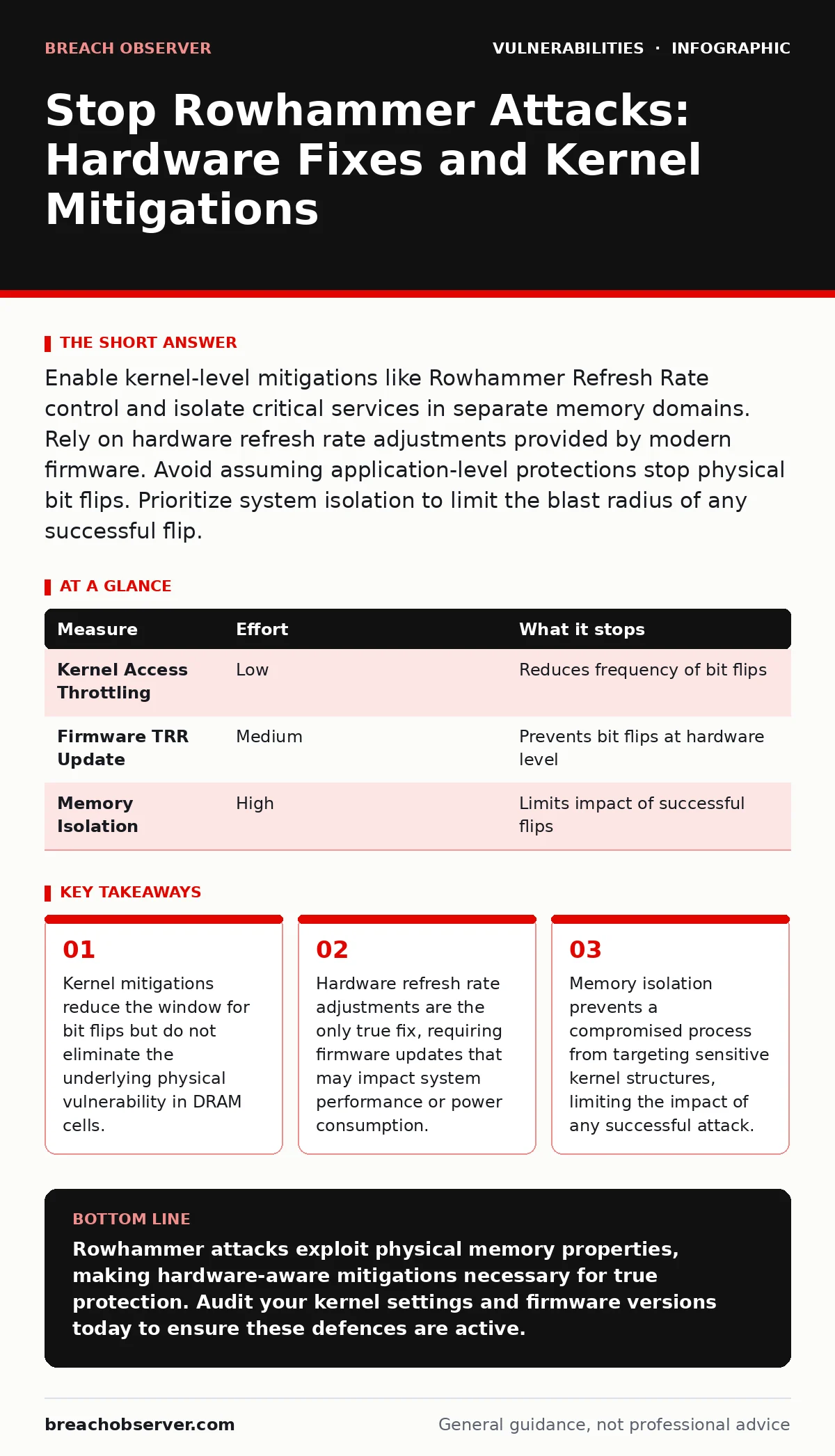
Enable kernel-level mitigations like Rowhammer Refresh Rate control and isolate critical services in separate memory domains. Rely on hardware refresh rate adjustments provided by modern firmware. Avoid assuming application-level protections stop physical bit flips. Prioritize system isolation to limit the blast radius of any successful flip.
Understanding the Physical Mechanism
Rowhammer attacks exploit a physical property of dynamic random access memory. DRAM stores data in tiny capacitors that leak charge over time. The memory controller refreshes these cells to maintain data integrity. When you repeatedly access a specific row of memory, electrical interference causes adjacent rows to lose charge faster than normal. This interference can flip bits from 0 to 1 or vice versa. The attacker does not need to read the data, only trigger the refresh failure. This physical phenomenon bypasses standard software security models.
Why Software Patches Are Insufficient
Standard software updates cannot change the physical characteristics of silicon. A kernel patch can detect rapid access patterns and slow them down, but it cannot stop the electrical leakage. The mitigation relies on statistical probability rather than absolute prevention. If the hardware refresh rate is too slow, or if the attacker uses a more aggressive technique, the software guard may fail. You must treat software mitigations as a delay tactic, not a solution. This distinction matters when you assess the residual risk of your infrastructure.
Priority One: Enable Kernel Mitigations
The first practical step is to ensure your operating system enforces access pattern limits. Modern kernels include features that monitor row activation rates. When the kernel detects a process hammering a specific memory region, it can throttle that process or isolate it. This reduces the frequency of bit flips significantly. You must verify that these settings are active in your system configuration. Disabling these features for performance gains exposes your system to immediate risk. Check your kernel parameters to confirm these protections are enabled by default.
Priority Two: Firmware and Hardware Refresh Rates
The most effective defence requires cooperation from the hardware manufacturer. Newer memory chips include a feature called Targeted Row Refresh. This allows the memory controller to refresh specific rows that are being hammered, rather than refreshing the entire bank. You must update your system firmware to support this feature. Without firmware support, the kernel mitigations have less data to work with. Contact your hardware vendor to confirm that your server or device supports targeted refresh mechanisms. This update often involves a BIOS or UEFI flash procedure.
| Measure | Effort | What it stops |
|---|---|---|
| Kernel Access Throttling | Low | Reduces frequency of bit flips |
| Firmware TRR Update | Medium | Prevents bit flips at hardware level |
| Memory Isolation | High | Limits impact of successful flips |
Priority Three: Isolate Critical Memory Regions
You cannot always trust the physical memory to remain stable. Therefore, you must assume that bit flips can occur. The strategy here is to limit what an attacker can do with a flipped bit. By isolating critical processes in separate memory domains, you prevent a compromised user-space application from affecting the kernel or other services. This approach aligns with the principles of exposure management, where you reduce the attack surface by separating components. If a bit flip occurs in an isolated sandbox, the damage remains contained.
See also: Zero-Click Exploit Warning Signs and Immediate Response Actions · Remediation Tracking: How to Close Vulnerabilities Before Exploitation
The Hidden Cost of Performance
Enabling aggressive Rowhammer mitigations introduces latency. Throttling memory access slows down applications that rely on high-frequency memory operations. Firmware updates for targeted refresh may also alter power profiles. You must balance security against performance requirements. In high-throughput environments, even small delays can accumulate. Test your systems under load after enabling these features. Do not assume the performance impact is negligible. Measure the actual throughput changes before deploying to production environments.
What Does Not Work
Many teams assume that standard encryption stops Rowhammer attacks. Encryption protects data at rest and in transit, but it does not prevent the bit flip itself. If an encrypted bit flips, the decryption process may fail or produce corrupted data. In some cases, the corruption can be exploited to bypass authentication checks. This misunderstanding is similar to assuming that Content Security Policy stops all JavaScript injection. The protection layer must match the attack vector. Physical memory attacks require physical or low-level software defences.
Immediate Actions for Your Team
You need to act on three specific areas today. First, audit your kernel configuration to ensure Rowhammer mitigations are enabled. Second, check your hardware inventory for firmware versions that support targeted row refresh. Third, review your service architecture to ensure critical processes are isolated from untrusted inputs. These steps reduce the likelihood of a successful attack and limit the damage if one occurs. Do not wait for a breach to validate these measures. The physical nature of the threat means the risk is always present.
Integrating with Broader Security Practices
Rowhammer defence is not an isolated task. It connects to your overall remediation tracking processes. When you identify a system lacking firmware support, you must schedule the update. This update is a remediation task that requires testing and validation. Treat it with the same rigor as patching for pre-authentication vulnerabilities. The difference is that the patch is in the firmware, not the application code. Coordinate with your hardware procurement team to ensure new devices support these features. This proactive approach reduces long-term maintenance costs.
Key takeaways
- Kernel mitigations reduce the window for bit flips but do not eliminate the underlying physical vulnerability in DRAM cells.
- Hardware refresh rate adjustments are the only true fix, requiring firmware updates that may impact system performance or power consumption.
- Memory isolation prevents a compromised process from targeting sensitive kernel structures, limiting the impact of any successful attack.
Rowhammer attacks exploit physical memory properties, making hardware-aware mitigations necessary for true protection. Audit your kernel settings and firmware versions today to ensure these defences are active.
Frequently asked questions
Does enabling ASLR stop Rowhammer attacks?
Address Space Layout Randomization randomizes memory locations, but it does not prevent the physical bit flips caused by row hammering. The attack targets the hardware, not the address space.
Can I detect a Rowhammer attack in progress?
Kernel logs may show throttling warnings when the system detects aggressive memory access patterns. These logs indicate the mitigation is working, not necessarily that an attack succeeded.
Do all modern servers support Targeted Row Refresh?
Most servers manufactured in recent years support this feature, but you must verify the specific firmware version. Older hardware may lack the necessary controller support.
Is Rowhammer a risk for cloud environments?
Yes, multi-tenant cloud environments are particularly vulnerable because one tenant can potentially hammer the memory of another. Cloud providers must implement these mitigations at the hypervisor level.
How this guide was produced: written by the Breach Observer editorial team with AI assistance, checked against the public references listed below, and reviewed when the facts change. See our editorial policy or report an error.