
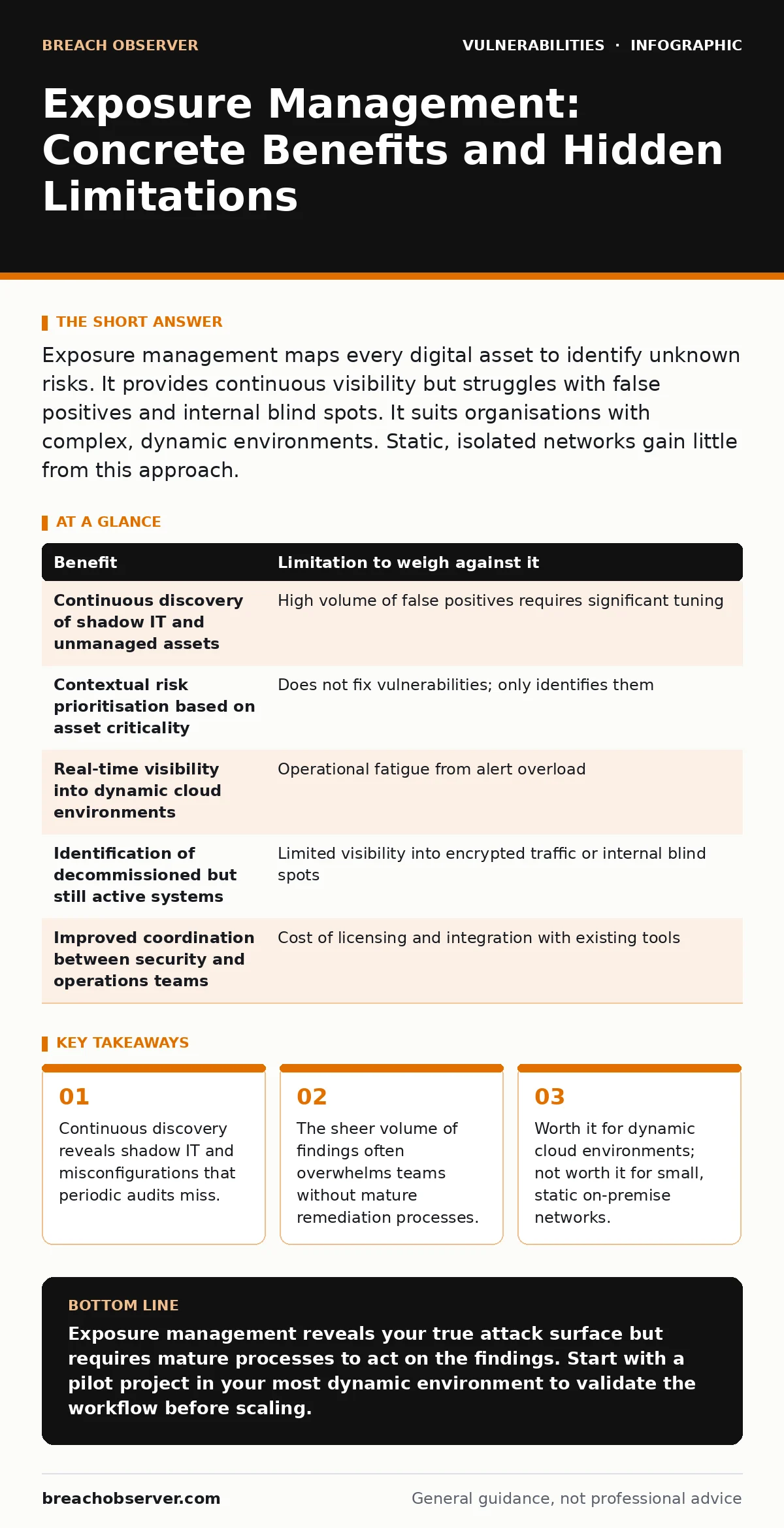
Exposure management maps every digital asset to identify unknown risks. It provides continuous visibility but struggles with false positives and internal blind spots. It suits organisations with complex, dynamic environments. Static, isolated networks gain little from this approach.
What exposure management actually achieves
Exposure management is a continuous process that identifies, prioritises and remediates security risks across an organisation’s entire digital footprint. It moves beyond traditional point-in-time assessments to provide a living map of your attack surface. This approach ensures you know what assets exist, who has access to them, and how they are configured.
The primary mechanism is automated scanning and correlation. Tools ingest data from cloud providers, endpoint agents and network traffic to build a unified view. This view connects a vulnerable server to the specific application it hosts and the business function that depends on it. Context transforms a raw vulnerability list into an actionable risk profile.
You gain visibility into assets you did not know you owned. Shadow IT, decommissioned servers still running and misconfigured storage buckets appear in the map. This discovery is the foundation of all subsequent security work. Without knowing what you have, you cannot protect it. The benefit is not just finding flaws, but understanding the relationship between assets and risk.
The hidden cost of visibility
The limitation of exposure management is information overload. Most organisations possess far more assets than their security teams can remediate in a reasonable timeframe. The tools generate thousands of findings, many of which are low-risk or false positives. Sorting signal from noise requires significant manual effort and sophisticated tuning.
This fatigue leads to alert blindness. Security analysts ignore high-severity alerts because they are buried under hundreds of low-severity ones. The system becomes a source of stress rather than clarity. You may find yourself chasing ghosts while real threats persist in the background. The cost is not just financial but operational, draining the capacity of your team.
Another hidden cost is the false sense of security. Having a map of your exposure does not mean you are secure. It means you know where you are vulnerable. If you lack the resources to fix the identified issues, the map simply highlights your helplessness. Exposure management exposes gaps; it does not fill them.
When exposure management is worth it
Exposure management is worth it when your environment is dynamic and complex. Organisations using multiple cloud providers, hybrid infrastructure or DevOps pipelines benefit most. These environments change hourly. Traditional quarterly audits are obsolete by the time they are completed. Continuous monitoring captures changes as they happen.
Consider organisations with a large attack surface. If you have thousands of internet-facing endpoints, the probability of a breach increases with each new asset. Exposure management helps you shrink this surface by identifying unused or unnecessary assets. You can decommission what you do not need, reducing the number of doors attackers can try to open.
It is also worth it when you have a mature remediation process. If your team can triage, prioritise and fix vulnerabilities quickly, the volume of data becomes an asset rather than a liability. The tool accelerates your workflow by providing context. You fix the most critical issues first, based on actual risk rather than severity scores alone.
When exposure management is not worth it
Exposure management is not worth it for small, static environments. If you have a few on-premise servers that rarely change, a monthly scan is sufficient. The complexity and cost of continuous exposure management outweigh the benefits. You do not need a jet engine to move a bicycle.
It is not worth it if you lack basic security hygiene. If you cannot patch known vulnerabilities or enforce multi-factor authentication, adding visibility will not help. You will discover more problems than you can fix. The frustration will lead to tool abandonment. Fix the fundamentals first. Build a solid foundation before adding advanced monitoring layers.
It is also not worth it if you cannot act on the data. If your organisation lacks the authority or resources to enforce changes, exposure management becomes a reporting exercise. You will produce detailed maps of your vulnerabilities but make no progress in reducing them. The tool becomes a shelf ornament rather than a security asset.
Benefits versus limitations weighed
| Benefit | Limitation to weigh against it |
|---|---|
| Continuous discovery of shadow IT and unmanaged assets | High volume of false positives requires significant tuning |
| Contextual risk prioritisation based on asset criticality | Does not fix vulnerabilities; only identifies them |
| Real-time visibility into dynamic cloud environments | Operational fatigue from alert overload |
| Identification of decommissioned but still active systems | Limited visibility into encrypted traffic or internal blind spots |
| Improved coordination between security and operations teams | Cost of licensing and integration with existing tools |
See also: Remediation Tracking: How to Close Vulnerabilities Before Exploitation · Vendor Patch Cycles: Why Timing Dictates Your Security Posture
Integrating with existing security frameworks
Exposure management does not replace other security measures. It complements them. You still need regular penetration testing to validate findings. You still need to follow WordPress plugin update policies to keep your websites secure. You still need to monitor for buffer overflow vulnerabilities in your applications.
The integration lies in the workflow. Exposure management identifies the assets. Penetration testing validates the risk. Vulnerability management patches the flaws. This cycle creates a continuous improvement loop. You move from finding problems to fixing them efficiently. The map guides the remediation efforts, ensuring you spend time on the most critical issues.
Addressing internal blind spots
One limitation of external-facing exposure management is the blind spot inside your network. Attackers who breach the perimeter often move laterally, exploiting internal weaknesses. External scanners cannot see these internal connections. You need internal sensors and agents to map the internal attack graph.
This internal visibility is crucial for understanding how a breach could spread. It shows which servers communicate with which databases. It identifies privilege escalation paths. Without this internal view, your exposure map is incomplete. You may secure the doors while the windows remain open.
Coordinated vulnerability disclosure helps address this. By working with researchers, you can learn about internal flaws before attackers exploit them. Out-of-band patches may be necessary for critical internal systems that cannot be taken offline for regular updates. This proactive approach reduces the window of opportunity for attackers.
The role of policy and governance
Exposure management is not just a technical tool. It requires policy and governance. You need clear rules for asset registration, configuration standards and remediation timelines. Without these rules, the tool generates data but no action. Governance ensures that findings lead to fixes.
Content Security Policy headers help protect your web applications from injection attacks. VPN appliance vulnerabilities must be addressed through strict configuration management. These policies reduce the number of findings your exposure management tool generates. Fewer findings mean less noise and more focus on critical risks.
The ultimate goal is risk reduction. Exposure management provides the data. Governance provides the structure. Together, they enable you to manage your security posture effectively. You move from reactive firefighting to proactive risk management. This shift is the true value of exposure management.
Key takeaways
- Continuous discovery reveals shadow IT and misconfigurations that periodic audits miss.
- The sheer volume of findings often overwhelms teams without mature remediation processes.
- Worth it for dynamic cloud environments; not worth it for small, static on-premise networks.
Exposure management reveals your true attack surface but requires mature processes to act on the findings. Start with a pilot project in your most dynamic environment to validate the workflow before scaling.
Frequently asked questions
How does exposure management differ from vulnerability scanning?
Vulnerability scanning identifies known flaws in specific assets. Exposure management maps all assets, their relationships and configurations to provide contextual risk prioritisation across the entire environment.
Can exposure management tools detect insider threats?
No. Exposure management focuses on asset visibility and configuration. Insider threat detection requires user behaviour analytics and monitoring of internal network traffic for anomalous activities.
What is the typical time to implement an exposure management programme?
Implementation varies based on environment complexity. A basic setup may take a few weeks. Full integration with remediation workflows and tuning to reduce false positives can take several months.
Does exposure management replace penetration testing?
No. Penetration testing validates the effectiveness of controls and finds logic flaws. Exposure management provides continuous visibility into assets and configurations. Both are necessary for a complete security posture.
How this guide was produced: written by the Breach Observer editorial team with AI assistance, checked against the public references listed below, and reviewed when the facts change. See our editorial policy or report an error.